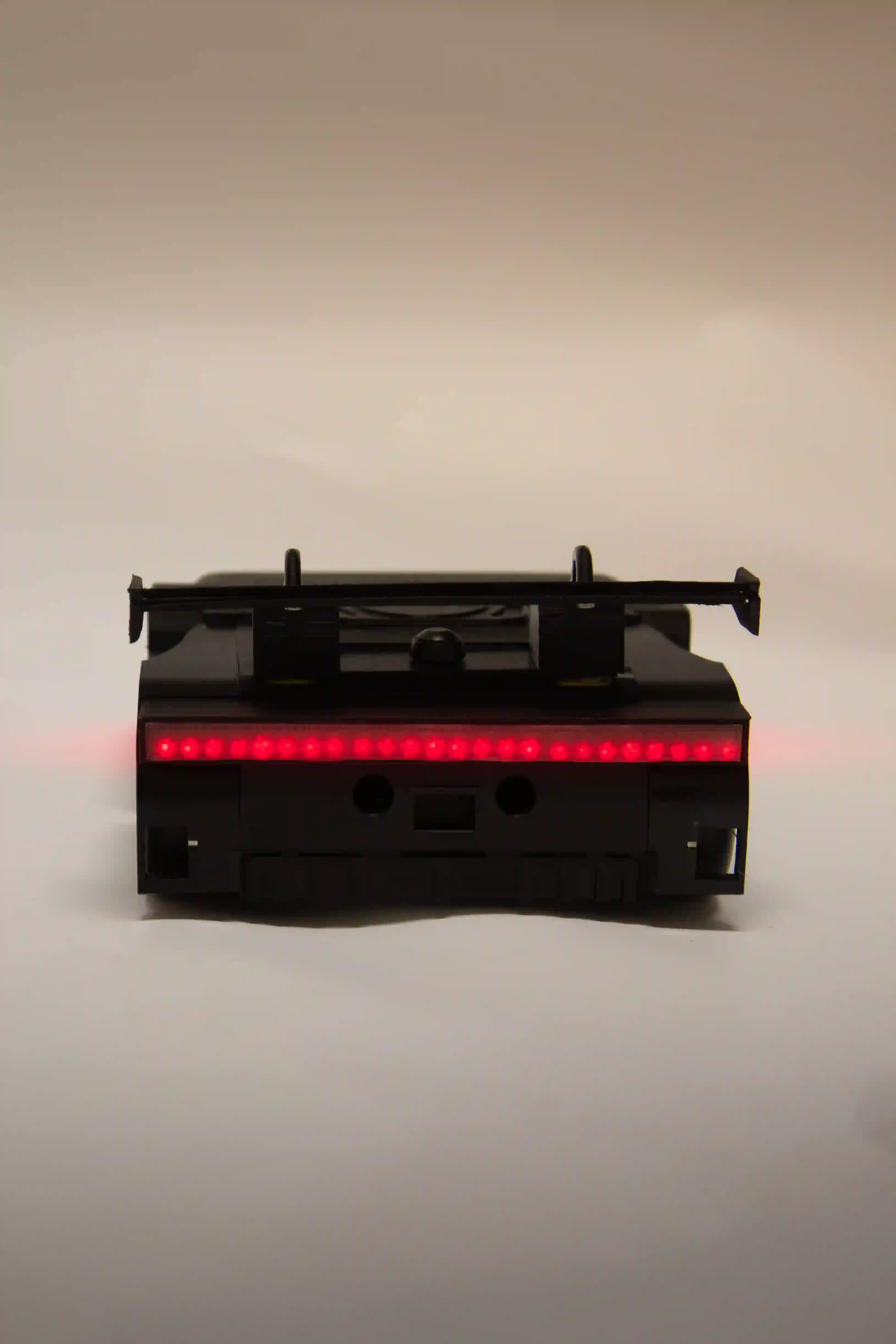
1. Introduction & Design Philosophy
The goal of this project was to engineer a fully autonomous robot capable of navigating a high-speed track with maximum precision. Rather than building a standard 'exposed PCB' robot, we aimed for a balance between raw performance and aerodynamic design, heavily inspired by the Mercedes-AMG GT3 race car. The challenge was to package high-performance electronics into a low-profile silhouette without compromising thermal management or serviceability.
2. Mechanical Engineering & Airflow
The chassis serves as a wind tunnel. Because the GT3-style body is fully enclosed, heat buildup from the high-torque motors and drivers was a critical concern. We designed a 3-Zone Airflow System:
- Central Tunnel: Air is intaked from the chassis floor and channeled directly over the Arduino Mega and Motor Drivers.
- Front Aero: Functional front splitters and wheel arches use low pressure to pull heat away from the front drive units.
- Rear Vents: Dedicated exhaust vents cool the rear motors, which handle the highest load during acceleration.
For serviceability, we implemented a 'Pit Stop' concept. The body is held by high-strength neodymium magnets and alignment pins, allowing the shell to be removed in seconds for battery swaps or diagnostics without tools.
3. Electronics: Distributed Architecture
To ensure zero latency in the control loop, we rejected a single-processor design in favor of a Dual-MCU Distributed Architecture:
- Master Node (Arduino Mega 2560): This acts as the brain stem. It is strictly dedicated to 'Hard Real-Time' tasks: reading the Pololu QTR-HD-07 high-density sensor array, calculating PID error corrections, and generating PWM signals for the motors.
- Slave Node (Arduino Nano): Handles the 'Human-Machine Interface'. It manages the dynamic lighting (brake lights via accelerometer, turn signals via G-force calculations) and system status LEDs.
This separation ensures that heavy processing for visual effects never delays the critical steering loop by even a single millisecond.
4. Algorithms & Control Logic
The robot uses a sophisticated PID (Proportional-Integral-Derivative) controller. We utilize a weighted average algorithm on the high-density sensor array to detect the line position with sub-millimeter accuracy.
To handle complex track topologies, we implemented specific behaviors: Differential Braking allows for skid-steering in sharp corners, while a 'Memory Mode' allows the robot to bridge gaps in dashed lines by maintaining its last known vector. An integrated accelerometer triggers braking lights during deceleration, mimicking real vehicle telemetry.
5. Manufacturing & Materials
The build process relied on advanced FDM 3D printing techniques. Safety was paramount, so the main structural chassis is printed in Prusament PETG V0 (Self-Extinguishing) to contain any potential electrical faults. The aesthetic bodywork is printed in Prusament ASA, which was then chemically smoothed using acetone vapor to achieve a glossy, automotive finish.
We overcame significant manufacturing hurdles, including diagnosing G-code data corruption that caused print failures and managing the hygroscopic nature of ASA filament by implementing strict drying protocols before fabrication.